Recent news involving a student and the subsequent disclosure of an autism diagnosis has understandably generated widespread discussion and concern.
First and foremost, our thoughts are with everyone directly affected by this tragic incident, especially the victim, their family, and the wider school community. We hope for healing, justice, and a thorough investigation that establishes the facts.
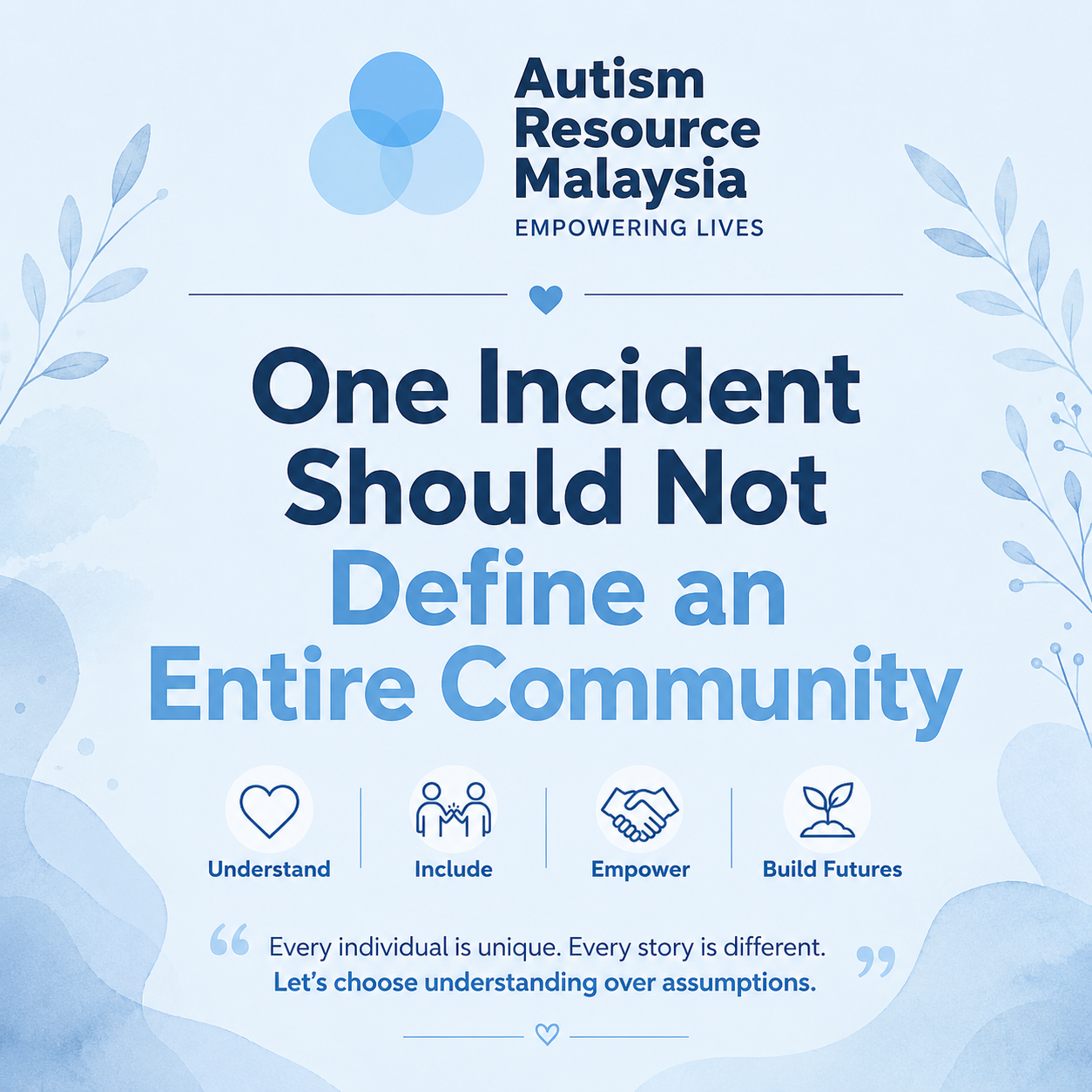
At the same time, Autism Resource Malaysia (ARM) would like to encourage the public to exercise caution before drawing conclusions about autism based on a single incident.
Autism Spectrum Disorder (ASD) is a neurodevelopmental condition. It affects how individuals communicate, interact socially, process information, and experience the world around them. It is not a predictor of violent behaviour.
Like the general population, autistic individuals are unique. Each person has different strengths, challenges, personalities, life experiences, and support needs. It would be inaccurate and unfair to judge an entire community based on the alleged actions of one individual.
Unfortunately, high-profile incidents can unintentionally reinforce stereotypes that many autistic individuals and their families have spent years trying to overcome. Such assumptions may lead to misunderstanding, discrimination, social isolation, and unnecessary fear towards people who have done nothing wrong.
We have also noticed considerable public confusion regarding autism terminology. Many comments online have mixed together Autism Spectrum Disorder (ASD), ADHD, Asperger syndrome, and ASD support levels. These are related but distinct concepts, and misunderstanding them can unintentionally spread misinformation.
As a community organisation dedicated to improving understanding and supporting autistic individuals throughout adolescence and adulthood, ARM believes that public education is one of the most effective ways to reduce stigma.
Over the coming days, we will be sharing a series of educational resources covering topics including:
- What Autism Spectrum Disorder (ASD) actually means
- Understanding ASD Levels 1, 2, and 3
- The differences between autism, ADHD, and the former Asperger diagnosis
- Common myths and misconceptions about autism
- How we can discuss autism responsibly during high-profile news events
Our hope is that these resources will encourage informed conversations based on facts, compassion, and understanding rather than assumptions.
At ARM, we believe that every autistic individual deserves to be seen as a person first—not defined by stereotypes or headlines.
Together, we can build a Malaysia that is better informed, more inclusive, and more compassionate.
Autism Resource Malaysia (ARM)
Comments are closed